Pamphlets and Polemics in the 17th-Century Ottoman Empire
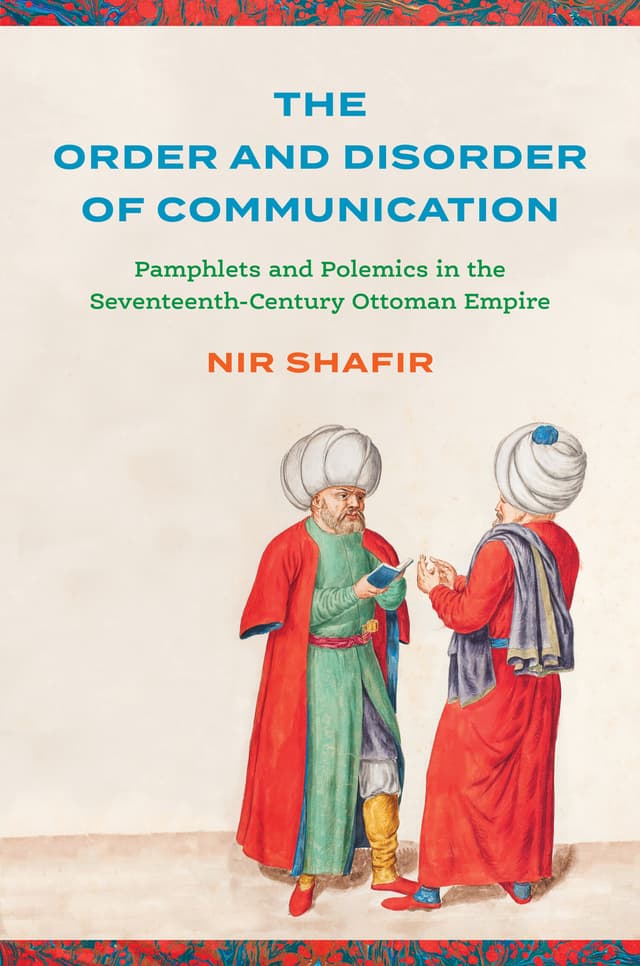
| The seventeenth century has often been characterized as a period of disorder and religious polemics in the Ottoman Empire. In this podcast, Nir Shafir takes us inside his award-winning new book, which argues that the polemics of the early modern Ottoman world were fueled in part by changes in communication, namely the rise of short pamphlets that circulated easily in handwritten copies. Pamphlets created a new arena largely independent from the institutional centers of knowledge production where people debated everyday questions of the time about what it meant to be Muslim. In exploring the world of Ottoman pamphlets, Shafir also offers a new introduction to the nature of Ottoman education, book production, and reading practices prior to the rise of print and modern state institutions.

 | Click for RSS Feed | 
|

|
The seventeenth century has often been characterized as a period of disorder and religious polemics in the Ottoman Empire. In this podcast, Nir Shafir takes us inside his new book, which argues that the polemics of the early modern Ottoman world were fueled in part by changes in communication, namely the rise of short pamphlets that circulated easily in handwritten copies. Pamphlets created a new arena largely independent from the institutional centers of knowledge production where people debated everyday questions of the time about what it meant to be Muslim. In exploring the world of Ottoman pamphlets, Shafir also offers a new introduction to the nature of Ottoman education, book production, and reading practices prior to the rise of print and modern state institutions.
Contributor Bios
 |
Nir Shafir is Associate Professor of History at University of California, San Diego. His first book, The Order and Disorder of Communication: Pamphlets and Polemics in the Seventeenth-Century Ottoman Empire (Stanford, 2024), was awarded 2025 Book Prize from the Ottoman and Turkish Studies Association. Shafir is also a longtime contributor to the Ottoman History Podcast, formerly serving as editor-in-chief and appearing in over 50 episodes since 2013. |
 |
Maryam Patton is Assistant Professor of History at Wesleyan University. Her research interests span the cultural and intellectual history of the late medieval and early modern Ottoman Empire, the history and theories of time and temporality, and cross-cultural transmission in the Mediterranean world, among others. She received her PhD in History and Middle Eastern Studies from Harvard University and is preparing her first book on the Ottoman conception of time. |
Credits
Episode No. 576
Release Date: 6 December 2025
Sound production by Maryam Patton
Music: "Vibing Over Venus" by Kevin MacLeod
Music: "Vibing Over Venus" by Kevin MacLeod
Further Listening
 |
Helen Pfeifer | 524
3/27/22
|
Scholarly Salons in 16th-Century Damascus |
 |
Carlos Grenier | 520
2/4/22
|
The Spiritual Vernacular of the Early Ottoman Frontier |
 |
Nir Shafir | 400
2/2/19
|
Forging Islamic Science |
 |
Konrad Hirschler | 380
9/25/18
|
The Many Lives of a Medieval Library |
 |
Harun Küçük | 456
3/25/20
|
Science in Early Modern Istanbul |
 |
Cemal Kafadar | 464
6/29/20
|
Between Past and Present, Part 1 |
Select Bibliography
Abou-El-Haj, Rifaʻat Ali. Formation of the Modern State: The Ottoman Empire, Sixteenth to Eighteenth Centuries. 2nd ed. Syracuse University Press, 2005.
Atçil, Abdurrahman. 2017. Scholars and Sultans in the Early Modern Ottoman Empire. Cambridge, United Kingdom: Cambridge University Press.
Atiyeh, George N. 1995. The Book in the Islamic World : The Written Word and Communication in the Middle East. [Washington, D.C.]: Library of Congress.
Bauer, Thomas. A Culture of Ambiguity: An Alternative History of Islam. Columbia University Press, 2021.
Burak, Guy. 2015. The Second Formation of Islamic Law : The Ḥanafī School in the Early Modern Ottoman Empire. New York, NY, USA: Cambridge University Press.
Dankoff, Robert, and Gottfried Hagen. 2006. An Ottoman Mentality : The World of Evliya Çelebi. Rev. 2nd ed. Leiden: Brill.
Erünsal, İsmail E. 2022. A History of Ottoman Libraries. Brookline: Academic Studies Press.
Fleischer, Cornell H. 1986. Bureaucrat and Intellectual in the Ottoman Empire : The Historian Mustafa Ali (1541-1600). Princeton, N.J.: Princeton University Press.
Grehan, James. Everyday Life & Consumer Culture In 18th-century Damascus. University of Washington Press, 2007.
Gürbüzel, Aslıhan. Taming the Messiah: The Formation of an Ottoman Political Public Sphere, 1600-1700. University of California Press, 2023.
Hanna, Nelly. 2003. In Praise of Books : A Cultural History of Cairo’s Middle Class, Sixteenth to the Eighteenth Century. 1st ed. Syracuse, N.Y.: Syracuse University Press.
Hirschler, Konrad. 2012. The Written Word in the Medieval Arabic Lands : A Social and Cultural History of Reading Practices. Edinburgh: Edinburgh University Press.
Kafadar, Cemal. 1995. Between Two Worlds : The Construction of the Ottoman State. Berkeley: University of California Press.
Karateke, Hakan T., and Maurus Reinkowski. 2005. Legitimizing the Order : The Ottoman Rhetoric of State Power. Leiden: Brill.
Messick, Brinkley Morris. 1993. The Calligraphic State : Textual Domination and History in a Muslim Society. Berkeley: University of California Press.
Pfeifer, Helen. 2022. Empire of Salons : Conquest and Community in Early Modern Ottoman Lands. Princeton, New Jersey: Princeton University Press.
Sajdi, Dana. 2013. The Barber of Damascus Nouveau Literacy in the Eighteenth-Century Ottoman Levant. 1 ed. Stanford, California: Stanford University Press.
Sezer, Elif. 2015. The Oral and the Written in Ottoman Literature : The Reader Notes on the Story of Fîrûzşâh. First edition. Istanbul: Libra Kitapçılık ve Yayıncılık.
Schwartz, Kathryn A. 2017. “Did Ottoman Sultans Ban Print?” Book History 20: 1–39.
Şen, A. Tunç. "The Sultan's Syllabus Revisited : Sixteenth-Century Ottoman Madrasa Libraries and the Question of Canonization." Studia Islamica, vol. 116, no. 1, 1 Jan. 2021, pp. 198 - 235.
El Shamsy, Ahmed. 2020. Rediscovering the Islamic Classics : How Editors and Print Culture Transformed an Intellectual Tradition. Princeton, New Jersey: Princeton University Press.
Sŭbev, Orlin. 2018. Waiting for Müteferrika : Glimpses of Ottoman Print Culture. Brighton, MA: Academic Studies Press.
Tezcan, Baki. 2010. The Second Ottoman Empire : Political and Social Transformation in the Early Modern World. New York: Cambridge University Press.
Zilfi, Madeline C. 1988. The Politics of Piety : The Ottoman Ulema in the Postclassical Age (1600-1800). Minneapolis, MN, U.S.A.: Bibliotheca Islamica.


Comments
Post a Comment
Due to an overwhelming amount of spam, we no longer read comments submitted to the blog.