Film Diplomacy in Turkey-US Relations
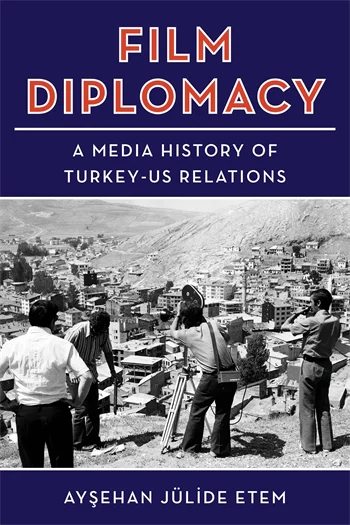
| During the Cold War period, Turkish cinema flourished, as American films entered local theaters, television sets, and the studios of Yeşilçam. Yet as Jülide Etem argues in her new book, Film Diplomacy, the cinematic story of Turkey-US relations begins not with entertaining Hollywood movies that circled the globe but rather educational film productions that simultaneously furthered the interests of American overseas power and Turkish domestic policy. In this episode, we explore how film became a ubiquitous technology and tool of the nation-state in Turkey through informational movies, educational material designed for the classroom, and place-based documentaries that performed the dual role of promoting tourism and cultivating knowledge of the country's different provinces among its citizens. As Etem explains, these ambivalent co-productions shaped an image of Turkey's inclusion in the international order, making film an arena in which visions of Turkey could be used to reify notions of American supremacy, as the Turkish national elite claimed their own place among the white Euro-American civilizations that became as models for values like development and progress in the modern world.

 | Click for RSS Feed | 
|

|
During the Cold War period, Turkish cinema flourished, as American films entered local theaters, television sets, and the studios of Yeşilçam. Yet as Jülide Etem argues in her new book, Film Diplomacy, the cinematic story of Turkey-US relations begins not with entertaining Hollywood movies that circled the globe but rather educational film productions that simultaneously furthered the interests of American overseas power and Turkish domestic policy. In this episode, we explore how film became a ubiquitous technology and tool of the nation-state in Turkey through informational movies, educational material designed for the classroom, and place-based documentaries that performed the dual role of promoting tourism and cultivating knowledge of the country's different provinces among its citizens. As Etem explains, these ambivalent co-productions shaped an image of Turkey's inclusion in the international order, making film an arena in which visions of Turkey could be used to reify notions of American supremacy, as the Turkish national elite claimed their own place among the white Euro-American civilizations that became as models for values like development and progress in the modern world.
Contributor Bios
 |
Ayşehan Jülide Etem is assistant professor of media studies and director of the film studies concentration at the University of Virginia. She is the author of Film Diplomacy: A Media History of Turkey-US Relations (Columbia University Press, 2026). |
 |
Chris Gratien is Associate Professor of History at University of Virginia, where he teaches classes on global environmental history and the Middle East. His first book, The Unsettled Plain: An Environmental History of the Late Ottoman Frontier, explores the social and environmental transformation of the Adana region of Southern Turkey during the 19th and 20th century. His current project, provisionally titled The Book and the Sword: Civil War and Reconstruction in Late Ottoman Syria, offers a global microhistory of the Tanzimat period, centered on the unsolved murder of an American missionary in the Ottoman Empire. |
 |
Sıla Önder is a PhD student in the Department of History at the University of Virginia. |
Credits
Episode No. 587
Release Date: 4 June 2026
Recording Location: University of Virginia
Sound production by Chris Gratien. Closing music by Kara Güneş.
Clips featured in the podcast in order: Tokat Belgeseli, 1975 (via YouTube); Turkey: A Middle East Bridgeland (via T.C. Kültür ve Turizm Bakanlığı); Turkey, 1949 (via YouTube) Bibliography and images courtesy of Jülide Etem
Release Date: 4 June 2026
Recording Location: University of Virginia
Sound production by Chris Gratien. Closing music by Kara Güneş.
Clips featured in the podcast in order: Tokat Belgeseli, 1975 (via YouTube); Turkey: A Middle East Bridgeland (via T.C. Kültür ve Turizm Bakanlığı); Turkey, 1949 (via YouTube) Bibliography and images courtesy of Jülide Etem
Further Listening
 |
Barış Ünlü | 582
3/16/26
|
|
 |
Perin Gürel | 573
10/31/25
|
|
 |
Andrew Simon, Alia Mossallam, and Ziad Fahmy | 564
4/1/24
|
The Sound of Revolution in Modern Egypt
|
 |
Aslı Iğsız | 189
4/3/15
|
Cultural Policy and Branding in Turkey |
 |
Suzy Hansen | 386
10/15/18
|
America, Turkey, and the Middle East |
 |
Nicholas Danforth | 028
6/6/11
|
U.S.-Turkey Relations during the 1950s |
 |
Emmanuel Szurek | 290
1/4/17
|
The Politics of Turkish Language Reform |
Images

Shooting for Elif'in Çilesi. Courtesy of Jülide Etem.

Teachers of the Educational Film Center in Turkey. Courtesy of Jülide Etem.

Ahmed and Mike playing in Turkey: Middle East Bridgeland. Source: Indiana University Libraries, Moving Image Archive

Ahmed and Mike bid farewell in Turkey: Middle East Bridgeland. Source: Indiana University Libraries, Moving Image Archive
Further Reading
Acland, Charles R., and Haidee Wasson, eds. Useful Cinema. Duke University Press, 2020.
Aufderheide, Patricia. Documentary Film: A Very Short Introduction. Oxford University Press, 2007.
Belmonte, Laura A. Selling the American Way: U.S. Propaganda and the Cold War. Philadelphia: University of Pennsylvania Press, 2008.
Cain, Victoria. Schools and Screens: A Watchful History. MIT Press, 2021.
Gürel, Perin E. The Limits of Westernization: A Cultural History of America in Turkey. Columbia University Press, 2017.
Kraidy, Marwan. Hybridity, or the Cultural Logic of Globalization. Temple University Press, 2005.
Melnick, Ross. Hollywood’s Embassies: How Movie Theaters Projected American Power around the World. Columbia University Press, 2022.
Nicholas J. Cull, The Cold War and the United States Information Agency: American Propaganda and Public Diplomacy, 1945–1989 (Cambridge: Cambridge University Press, 2008).
Orgeron, Devin, Marsha Orgeron, and Dan Streible, eds. Learning with the Lights Off: Educational Film in the United States. Oxford University Press, 2011.
Painter, Nell Irvin. The History of White People. W. W. Norton & Company, 2011.
Salazkina, Masha. World Socialist Cinema: Alliances, Affinities, and Solidarities in the Global Cold War. Oakland: University of California Press, 2023.
Shah, Hemant. The Production of Modernization: Daniel Lerner, Mass Media, and the Passing of Traditional Society. Temple University Press, 2011.
Snow, Nancy. “Rethinking Public Diplomacy in the 2020s.” In Routledge Handbook of Public Diplomacy, 3–12. Routledge, 2020.
Snow, Nancy, and Nicholas J. Cull, eds. Routledge Handbook of Public Diplomacy. Routledge, 2020.
Stewart, Jacqueline Najuma. “Giving Voice, Taking Voice: Nonwhite and Nontheatrical.” Foreword to Screening Race in American Nontheatrical Film, edited by Allyson Nadia Field and Marsha Gordon, xi–xxiv. Durham, NC: Duke University Press, 2019.
Yesil, Bilge. Talking Back to the West: How Turkey Uses Counter-Hegemony to Reshape the Global Communication Order. University of Illinois Press, 2024.


Comments
Post a Comment
Due to an overwhelming amount of spam, we no longer read comments submitted to the blog.